
Federal Government vs. 7 Million Student Loan Defaulters
One key issue for the 2016 US election, is the default of debt by over 7 million students.
Lenders have trapped many with the financial burden, mainly because the careers they studied for, never came into existence once they were qualified.
Example:
If a firm lends out $200,000 for a qualified anthropologist, but there are not many job openings in the field, then the student still carries the debt, while not achieving the dream career they had hoped.
The Overall Consequence
At the moment, there’s an estimated 44 million Americans who are up to $1.3 trillion in debt (an average balance of $30k for each student).
16% of students have now defaulted on their loans – with costs of up to $125 billion so far in the nation’s budget.
The problem only seems to be getting worse.
Why can’t the borrowers pay it back?
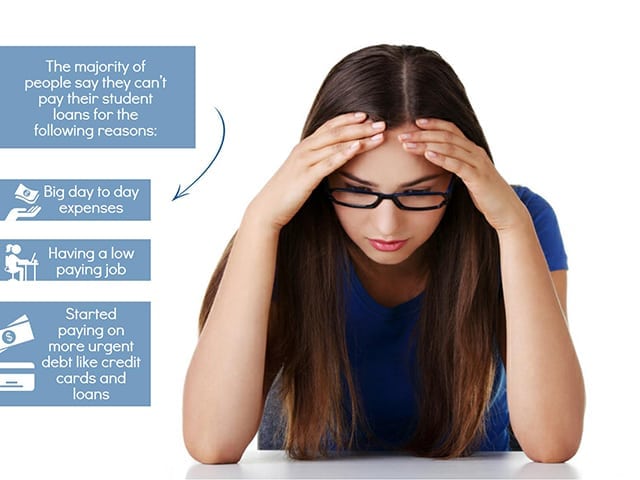
Some cases have been deliberate, where students felt angry and cheated from the situation, however for others the scenario is unavoidable due to the following factors:
- Not getting the desired salary and job, and instead turning to unskilled and low paid work.
- Many have just remained unemployed and moved back with their parents.
- The rise in the cost of living means they can’t afford to meet all their financial obligations.
One example of an angry student is Mr. Osborne, who studied to be in the health-care industry, and is now 45 with still no hope of getting his ideal career choice.
He stated, “Why should I give them a cent, for not delivering on a job promise that won’t ever happen?”
Effects on economy
Signs that high numbers are going to default on debt inevitably meant a much-weakened economy and was a similar story for the bankers in 2008 when the biggest recession during peace time was caused – since the 1930s depression.
These factors mean a large hole in taxpayers money, damaged credit that can spread across many markets, and citizens having little to no opportunity of saving and spending for their future (causing large and small businesses to suffer from low profits too) – effectively causing stagnation and no growth.
A graph analysis:
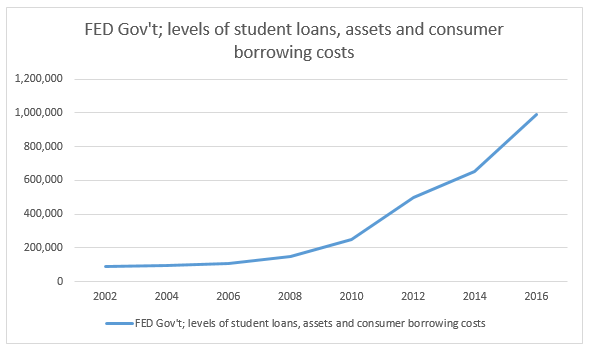
A look at the figures:
Since the 2007 financial crash, you can see that the burden of borrowing has increased drastically for the taxpayer, with no signs of a drop – even through times of economic austerity and recovery.
What the Fed has tried to do
The Obama administration has provided programs to help students by offering discounted monthly repayments and providing help to get their finances back on track (in some cases, even reducing the debt amount owed).
Also, for those who can prove of being defrauded by misleading school advertisements, the program can write off debt as well.
A more controversial move
The Fed has also made subsidiaries for borrowers’ wages, which has cost a further $515 million in the last nine months – meaning more excessive costs to the general taxpayers.
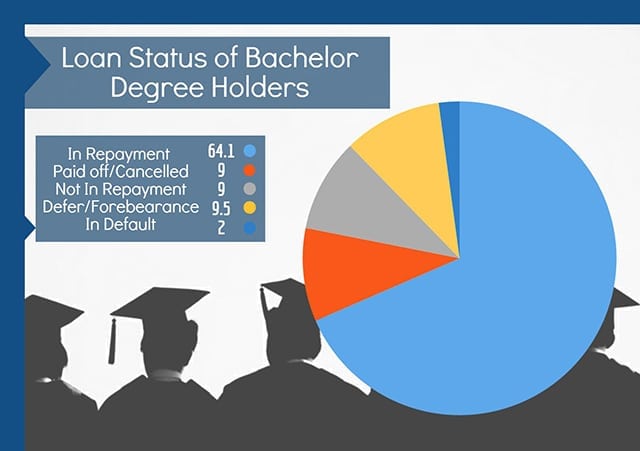
A pie chart showing the loan status of Bachelor degree holders, from 2009
Analysis:
This chart only displays a small slither of loan defaults, who would’ve been students that started studies around 2003-04 (and the data collected was only a year after the course had finished).
But another survey conducted another four years later didn’t show much change in the situation – which found only a small 2.4% of degree holders had defaulted.
These figures show that…
Although the fear of 7 million students being in debt has been hyped up in headlines, the problem could potentially be a case of fear-mongering with no basis, and for those who have defaulted could’ve also been for these reasons:
- Students may not have passed exams to achieve the degree.
- Many may have had high expectations, to begin with, and thought could walk into a high-end job – with no efforts to start at the bottom and climb the career ladder.
- The career choice didn’t match their expectations.
- Others may have just chosen not to repay their loans.
- Left in the middle of studies to work full-time or care for a sick relative.
Each person’s circumstance can’t necessarily be generalized into one problem, which can make it much more problematic for the Fed to resolve.
Behavioral scientists
The education department has witnessed a little change in loan defaults over the last few years and has now hired experts to get answers on getting information from borrowers, by testing things like time of day to send messages and the language used in emails.
Even the deputy secretary, Sarah Bloom Raskin, has engaged with students, to get ideas of what new policies can help the situation.
She says that patterns are all too similar to homeowners from the last recession, which needs urgent attention.
How much debt do students default on?
Collectively there’s a huge chunk owed between students.
The average student loan debt per head is $8,900.
If we go back to the Osbornes’, they studied at Abdill Career College Inc. (a school in Medford, which makes a small profit).
After they graduated as medical assistants in 2011, even though they had certificates, they were unable to find work.
Mr. Osborne was unhappy with the exaggeration of job likelihood and that the classes were of low-quality.
“They should have extended the debt, or been more honest about the jobs that are in weak demand,” he stated.
He trained to be a phlebotomist, who typically earn $32,000 a year (said by the Labor Department), and 1 in 5 borrowers from Abdill have defaulted on their loan in 3 years.
This brought up the default rate to around 20%, whereas usually, the national average is 12% from colleges.
The owner from Abdill refused to comment, but did confirm the Osborne’s did study at the school – privacy laws restrained her from discussing details of their time there.
She stated, “We have now lowered tuition fees, and now prioritize students for finding jobs at the end of the course.”
Mr. Osborne currently…
He works for a solar-power firm, and earns $13 hourly in sales; his wife is a maid.
Although there are loads of reasons to be angry at the situation, officials are still very unsure on how many students are refusing to pay or just simply cannot afford it.
Another student story…
Jim Lopko, from Illinois, said that his interest skyrocketed on his balance, and wasn’t able to pay it back.
His student debt is over $122,000, which is a combination of federal and private loans.
He graduated from one course, but dropped out of the other (a bachelor’s program).
He could no longer do the second course as he had maxed out on his federal loans while being denied access to private borrowing.
Jim is now in default on both federal and private loans, with debt collectors now calling him daily – the stress and anxiety make him ignore calls.
Living in a Chicago suburb, and now on $32,000 a year salary as a customer-service agent.
He says: “I would only resolve this situation by either finding a job paying over $300,000 annually, or winning the lottery.”
Jim defended his splurging spending habits, though:
“I can’t have a life and never go out because I got to pay these loans?”
As he recently took out a new loan for a Subaru WRX and a one-bedroom apartment.
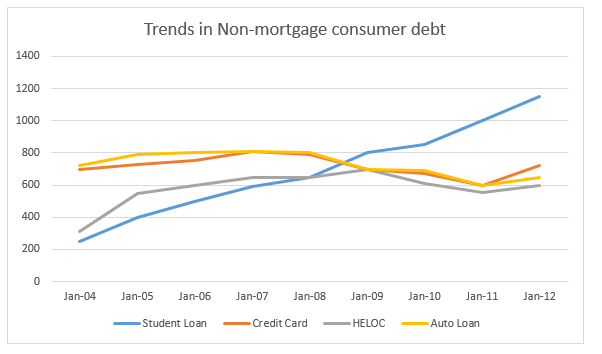
Comparison of Student debt vs non-mortgage consumer lending sources:
Graph Analysis:
As you can buy the chart trends, Student debt has risen solidly through the recession, whereas other lenders lost growth through the credit crunch in comparison.
Looking at policy review:
Seeing both sides of the argument, from students and the Fed, you can see many students were duped onto some courses and are then weighed down by a lifetime of debt.
The policy should ensure that schools are very honest with regards to the outcome of their courses, and for those that can prove they been misled should have the student loan written off.
However, each would be different in how they approach education, and should take the responsibility to do thorough research on their subject choices before going on the course.
Ways to research a course before getting started:
- Always check the state of the industry you are hoping to get into.
- Most markets have a form of online presence, so sign up to blogs and websites to get independent information; it won’t be biased in the schools favor when advertising places.
- Read and ask questions on forums; there’s many online who will share their experiences.
- Check the school’s website and look for any feedback from previous students (they may even disclose where they are now, after attending their Bachelor’s).
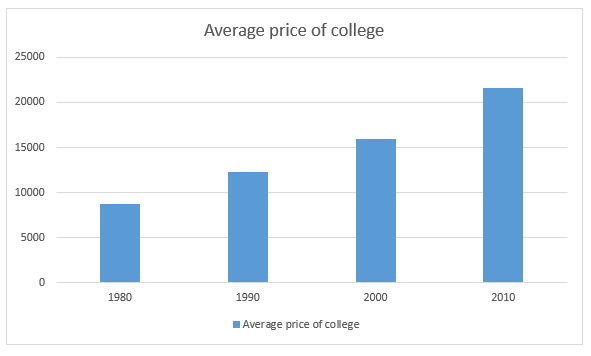
Average price of a 4-year college course:
Graph Analysis:
There’s no question that student debt has risen drastically over the last few decades, and it doesn’t look like it’s going to come down anytime soon.
In conclusion
Cases like this should not put you off on going to college, instead, do your homework and know what’s going on in the market exactly – at least we can learn from the mistakes of the past.